

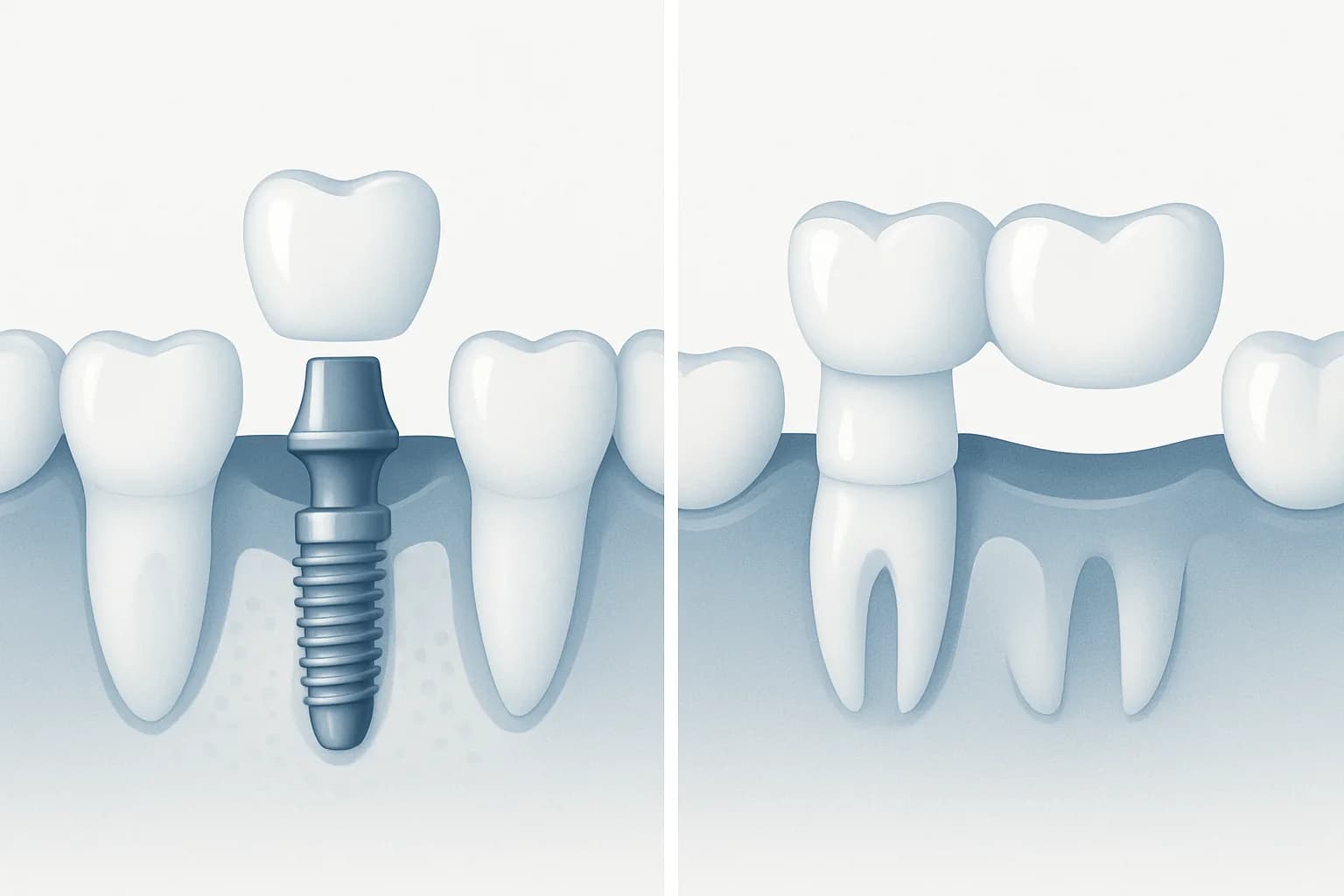
Losing a tooth affects how you chew, how your smile looks, and how nearby teeth hold up. For many Palo Alto patients, the decision between a dental implant and a dental bridge comes down to three practical concerns: how long the solution will last, how much treatment and cost are involved, and what fits your lifestyle and overall oral health.
This guide explains the difference in clear, nontechnical language so you can have a focused conversation at your visit with Dr. Wong instead of trying to piece together generic advice online.
What is a dental implant?
A dental implant replaces the tooth root with a small titanium post placed in the jaw. After healing, the implant is fitted with an abutment and a crown that looks and functions like a natural tooth. Implants are a surgical option, but they are often the most long-lasting solution for a single missing tooth.
If you want the full overview of how implant treatment works at this office, our dental implants page walks through planning, healing, and long-term maintenance in more detail.
What is a dental bridge?
A traditional fixed bridge replaces a missing tooth by anchoring a prosthetic tooth to crowns on the adjacent teeth. A bridge is not surgically anchored in the jaw. Bridges work well when the teeth next to the gap are healthy enough for crowns and when you want a faster path to a finished tooth.
Pros and cons at a glance
Dental implant
- pros: preserves the jawbone
- pros: does not require altering adjacent teeth
- pros: long lasting with good care
- pros: feels and functions like a natural tooth
- cons: requires a surgical procedure
- cons: longer overall timeline
- cons: higher upfront cost
Dental bridge
- pros: faster route to a finished tooth
- pros: no surgery in many cases
- pros: lower initial cost than an implant for some patients
- cons: requires shaping the adjacent teeth for crowns
- cons: can be harder to clean under the bridge
- cons: may need replacement sooner than an implant
How to decide: three clinical factors
1. Condition of the adjacent teeth
If the teeth next to the missing tooth already have large fillings or need crowns, a bridge can be an efficient way to restore function while addressing those teeth. If the adjacent teeth are healthy, it is often better to avoid reducing them and choose an implant.
This is one reason the answer is not purely about price. The more important question is what preserves the most healthy tooth structure over time.
2. Bone health and anatomy
An implant needs enough jawbone to hold the post. If bone loss has occurred, a bone graft may be recommended before implant placement. That adds time and cost, but it can provide a more durable long-term result.
Some patients hear that and assume a bridge is automatically better. Not always. If the goal is to replace one missing tooth without affecting the neighboring teeth, grafting may still be the better long-term move depending on the case.
3. Timeline and tolerance for multiple visits
If you need a quicker finish and want to avoid surgery, a bridge can deliver a reliable result in fewer visits. If you prefer a solution that minimizes changes to neighboring teeth and offers the most durable option, an implant is usually preferred.
This is where lifestyle matters. Busy Palo Alto professionals, parents, and Stanford-area patients often care just as much about predictability and scheduling as they do about the technical pros and cons.
Costs and insurance considerations
Costs vary by case and by restoration type. In Palo Alto, many patients find that implants have a higher initial cost but can be more cost effective over a decade because they often last longer. Bridges may cost less upfront, but they may need replacement sooner and they rely on the health of the supporting teeth.
Dr. Wong's office accepts major PPO plans, and the team helps verify coverage and estimate patient costs before treatment starts. The point is not to pressure you into the bigger treatment. It is to show you the full picture, including what each option may mean financially now and later.
What to expect at Dr. Wong's office
Initial consult
The first step is a focused evaluation. Your goals, digital images, bite, and the condition of the teeth around the space are reviewed. If an implant is appropriate, the discussion may include whether grafting or other preparation is needed.
Planning and treatment
For implants, digital planning is used to position the implant precisely. After placement there is a healing phase that can take several months depending on individual healing. Once healed, the abutment and custom crown are attached.
For bridges, the timeline is shorter. The anchor teeth are prepared, impressions or scans are taken, and the bridge is delivered once the lab work is ready.
This is where broader restorative dentistry planning matters. A missing tooth does not exist in isolation. Bite pressure, neighboring restorations, and long-term maintenance all affect which solution makes the most sense.
Care and maintenance
Both solutions require good oral hygiene.
- Implants need careful cleaning around the implant and crown to avoid peri-implant inflammation.
- Bridges require cleaning under the false tooth using floss threaders or special brushes.
- Regular checkups and cleanings extend the life of any restoration.
Neither option is truly maintenance free. The better question is which kind of maintenance fits you best.
Common patient questions
How long do implants last?
With proper care and regular monitoring, most implants last many years and often decades. The crown may need replacement over time due to normal wear.
Is the implant procedure painful?
Local anesthesia is used, and sedation options are discussed when appropriate. Most patients report mild discomfort during healing that is manageable with over-the-counter pain medication.
What if I already have some bone loss?
Minor bone loss is common and often manageable with grafting. Imaging can show whether grafting is recommended and how it affects the timeline.
Is one option always better?
No. The right choice depends on your oral health, your priorities, and your budget. The best treatment is the one that solves the problem conservatively and predictably for your specific case.
FAQ
Will insurance cover an implant?
Coverage varies. Many PPO plans cover a portion of implant crown work but treat the implant itself differently. The office can verify benefits and provide a written estimate.
How soon can I eat normally?
After a bridge, you can often return to a normal diet within a few days. With implants, a softer diet is usually recommended during the initial healing phase and then a gradual return to normal chewing as the implant integrates.
Can a bridge be converted to an implant later?
Sometimes. If the adjacent teeth have been reduced for crowns, conversion is possible but may involve additional steps. The best path depends on how much tooth structure is left and what will preserve your teeth long term.
A practical next step
If you are deciding between an implant and a bridge, book a focused consult with Dr. Wong. Digital imaging and clear estimates make it easier to compare outcomes, timelines, and costs without pressure.
If you want help thinking through which tooth replacement option fits your goals, contact the office to schedule a visit. The goal is a clear plan, not a sales pitch.
Restorative planning in Palo Alto
The right restoration is the one that protects the tooth without removing more structure than necessary. That is why treatment decisions are based on how much healthy tooth remains, how the tooth handles bite pressure, and how predictable the repair will be over time.
If you have a cracked tooth, a large older filling, or pain when chewing, an exam can clarify whether a filling, crown, or another restorative option is the safest long-term move.
- Treat cracks and failing fillings before they become emergencies
- Ask how much natural tooth structure remains
- Match the restoration to both function and long-term durability